This blog post focuses on a select sample of ThriveK12 wellbeing survey data of upper elementary students from 7 schools, middle schoolers from 6 schools, and educators from 7 public charter schools across the District. Schools are located in Wards 1, 4, 5, 7, and 8, and 58% of respondents identify as Black or African American and 20% identify as Hispanic or Latino. These schools have been continuous users of the ThriveK12 wellbeing surveys since fall 2020 and provided us with student fall-to-spring growth and attendance data from this year to identify additional correlations.
Key findings
Our spring ThriveK12 wellbeing surveys ask students and educators to answer asset-framed items in four key constructs: mental wellbeing, physical wellbeing, social wellbeing, and academic or professional wellbeing. Based on the analyzed sample of 497 students and 110 educators, we find that educator wellbeing index scores (p=0.06) and new "school climate" score (p=0.09) are statistically significantly correlated with fall-to-spring student growth in math and reading on a nationally normed assessment, NWEA MAP.
Previous ThriveK12 research with larger sample sizes found similar statistically significant correlations between student wellbeing index scores and academic growth. Here are additional key findings from the data:
The Good News
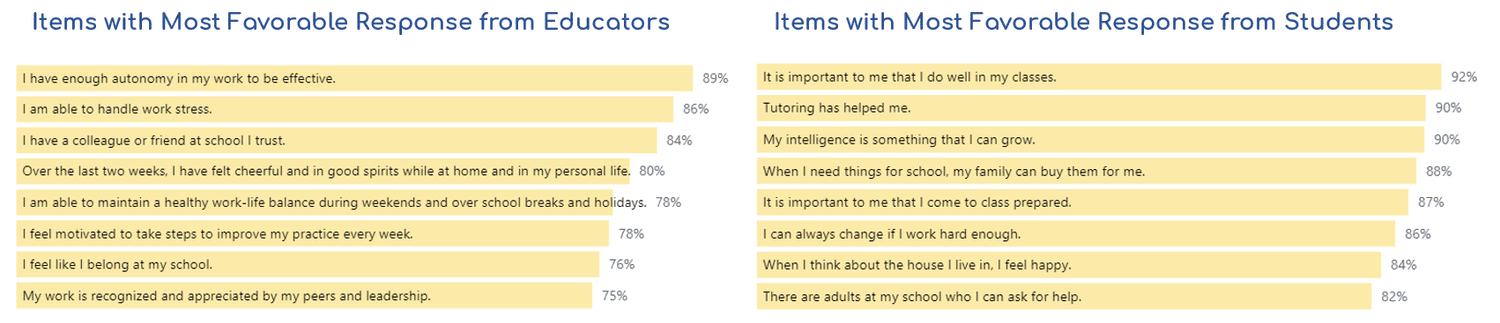
- Overall, student wellbeing index scores edged upwards (+4 points) from this fall's low point.
- Tutoring continues to be a bright spot with 90% of students who receive tutoring reporting that it is helpful. Students who receive tutoring were also statistically significantly more likely to agree that there is an adult from school they can go to for help (p<0.05), 84% for tutored students and 72% for untutored students.
- Most students have a growth mindset with 90% believing their intelligence is something they can grow and 86% agreeing that they can always change if they work hard enough.
- For educators, we saw significant year-over-year improvement in wellbeing index scores (+16 points) as well as broad agreement at sample schools that they have the autonomy to be effective (89%) and are able to handle work stress (86%).
Challenges
- Less than half of students agree that their peers are kind (48%) and want to keep them safe (48%).
- About one-third of students are struggling with holistic and mental wellbeing with 37% answering that they do not feel happy most days and 32% not feeling like they belong at their school. There is a statistically significant correlation between students' feelings of belonging and higher attendance rates, suggesting that strategies that help students feel like they belong with their peers and feel like being at school has a purpose will improve attendance at a time where chronic absenteeism remains high.
- Educators in our sample find physical wellbeing a challenge with just 50% reporting that they get enough sleep during the work week and can find time for fitness and exercise. Many educators (39%) do not feel like communication from their leaders is frequent and clear enough.
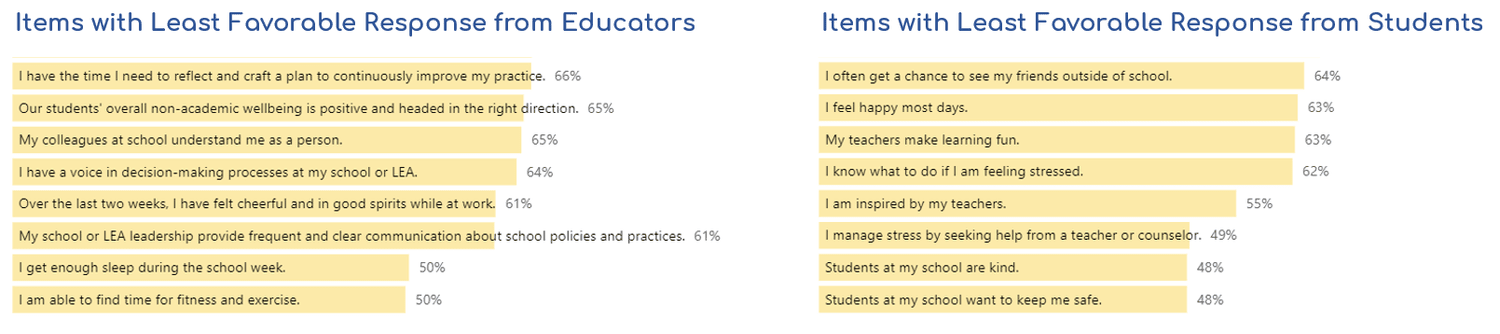
In our professional opinion, the student and educator survey data suggest that an emphasis on making school a fun and caring place for adults and students should be a challenge all schools aim to address in 2023-24.
Educator wellbeing matters
Our spring survey finds that educator wellbeing is linked to student growth in math and reading. Additional research may be required to fully understand the causal nature of this relationship. It could be that teachers who are less successful in the classroom have a lower sense of wellbeing, or teachers who struggle with personal wellbeing issues may be less effective teachers in the classroom.
In addition to high correlation with student growth, we find a statistically significant correlation between Educator Wellbeing Index Scores and our survey's new School Climate Subscore. Students at schools where educators had higher wellbeing index scores reported more agreement with the following items:
- I feel like I belong at my school.
- I know and feel loved by my teachers.
- My teachers make learning fun.
- There are adults at my school who I can ask for help.
Research around educator wellbeing and student outcomes is limited, but there are papers that corroborate the link between quality student-teacher relationships and educator wellbeing. Our ThriveK12 survey finding suggests that investment in strategies that support educator's holistic wellbeing can have a positive impact on student academic trajectories.
School climate matters
For the spring 2023 survey, we identified a subset of wellbeing survey items that addressed school climate and computed a "school climate subscore" based on rates of favorable responses to those items by students. We find a significant correlation between the School Climate Subscore and fall-to-spring growth demonstrated by students in math and reading (p=0.09). This finding demonstrates the promise that ThriveK12 surveys can reliably assess both holistic student wellbeing and school climate at the same time.
Spring survey items included in the pilot School Climate Subscore:
- I feel like I belong at my school.
- I know and feel loved by my teachers.
- I respect and trust my teachers.
- My teachers make learning fun.
- Students at my school are kind.
- There are adults at my school who I can ask for help.
- My intelligence is something that I can grow.
- During a typical 5-day school week, it is important that I attend school every day of the week.
- I am learning the skills to succeed in any career I want.
- I know about different career paths available to me after high school.
How educators can help students thrive
In the spirit of continuous improvement and fostering a positive learning environment, the spring ThriveK12 survey asked students to share their ideas on how to make school a better place. The responses were insightful, thoughtful, and demonstrated a deep sense of care and commitment to their school community. We categorized those ideas into three main areas: School Environment and Culture, Academic and Extracurricular Activities, and School Facilities and Resources.
School Environment and Culture
Students understand the importance of a positive and respectful school culture. They suggested that better behavior from peers, less bullying, and more respect would significantly improve the school environment. They suggested more group discussions about how they feel at school, highlighting the importance of emotional wellbeing and open communication in creating a supportive school culture.
Academic and Extracurricular Activities
Students expressed a desire for a broader range of activities, both academic and extracurricular. They believe that more sports activities would not only provide a positive break in the day but also contribute to improved physical health. They also suggested making learning more fun to boost academic performance. Field trips were a popular suggestion, with students noting that these experiences make school more enjoyable and educational as well as provide a refreshing break from the traditional school routine.
School Facilities and Resources
When it comes to school facilities and resources, students had clear ideas for improvement. A common recommendation was for better quality and variety in school lunches. They also suggested bigger playgrounds and improved sports facilities, like a better outside basketball court, emphasizing the importance of physical activity in the school day.
Additionally, we provide a repost from our. fall wellbeing results blogpost with important recommendations from our partners at GWU:
The Student Wellbeing survey asks students an open-ended question about what adults at school can do to better help them. Here are the most common requests:
- Students want teachers to understand their individual needs and learning styles. They suggest that teachers can provide one-on-one support and different opportunities for students at different skill levels. Students suggest that teachers can communicate more effectively by giving clear instructions, slowing down when giving instructions, and listening to them more closely.
- Students ask teachers to address bullying and create a safe and respectful environment in the classroom and discourage students from judging or talking about other's appearance.
- Students want their teachers to encourage them and push them to do better. They appreciate it when teachers are excited to teach, make learning fun, and offer advice on how to improve their performance. Teachers should also boost their students' confidence and make them feel welcomed at school and in the classroom.
- Students report hoping that their teachers will provide emotional support, listen to them, and check on them if they are feeling sad or struggling with something. Some students want their school to provide more opportunities for tutoring.
Our partners in this effort from the George Washington University's Center for Health and Health Care in Schools recommend the following strategies based on challenges identified in the data:
- Student Environmental Stress Recommendation: Schools should screen for social, economic, and environmental stressors that create instability, anxiety, and could prevent consistent school attendance. School behavioral health providers, school nurses or other pupil support staff can expand their screening and intake protocols to identify conditions that could become significant barriers to student learning.
- Social Connections Recommendation: The social isolation and peer rejection experienced by some students can lead to a host of social, emotional, and behavioral difficulties for students. Community building strategies, social skills groups, and classroom cooperative learning activities can allow students to get to know each other, build empathy, and help reduce the impact of these experiences.
- Bullying and Trauma Recommendation: School leaders and administrators can forge an integrated partnership with assigned community-based behavioral health partners to provide a broad array of prevention, early intervention, and treatment services. School-hired mental health staff and CBO clinicians can work collaboratively to expand the services and supports available to students and their families who have experienced, grief, loss, and/or trauma.
How leaders can help educators thrive
The role of school leaders extends beyond administrative tasks. They are the catalysts for creating an environment where educators thrive and students excel. How can school leaders effectively support their educators? We gathered open-ended insights directly from educators on the spring ThriveK12 educator wellbeing survey to help answer this question. Here's what they suggested:
Enhancing Communication and Community
Communication is the cornerstone of any successful team. Educators suggested in their responses that school leaders can foster a sense of belonging and shared purpose through open, frequent, and transparent communication. Regular meetings, updates, and open dialogues can help ensure everyone is working towards the same goals. Additionally, organizing community-based activities and celebrations can strengthen the sense of community, making schools a place where educators love to work and students love to learn.
Investing in Professional Development and Resources
Continuous learning is as crucial for educators as it is for students. Teachers say that school leaders can support them by investing in professional development opportunities, particularly in areas like trauma-informed teaching, diversity, equity, and inclusion (DEI), and understanding adverse childhood experiences (ACEs). Additionally, providing targeted support, resources, and mentorship for new teachers can help them navigate the initial challenges of their career. By investing in professional development, school leaders can equip their educators with the tools they need to succeed and grow.
Prioritizing Mental Health and Wellness
Teachers believe the demanding nature of their job calls for a strong focus on mental health and wellness. Disagreements and conflicts are inevitable in any workplace. One common idea is that school leaders can support their staff by providing training in conflict resolution, helping to ensure that when issues arise, they can be handled in a constructive and respectful manner. Focusing on this and other social-emotional strategies can not only help prevent burnout but also ensure that educators are at their best when interacting with students.
Establishing Clear Expectations and Providing Behavioral Support
Educators thrive in an environment where expectations are clear and accountability is maintained. School leaders can foster this by setting and communicating clear expectations for professional responsibilities. Additionally, providing behavioral support such as school-wide discipline policies, training on addressing challenging student behavior, and support for students with Individualized Education Programs (IEPs) can create a more conducive learning environment.
By focusing on these key areas, school leaders can create an environment where educators feel supported, valued, and empowered to do their best work. This not only benefits the educators but also leads to improved outcomes for students and a stronger school community.